
“The skills that meet this moment—self-awareness, nervous system regulation, the ability to stay present in hard conversations—are not soft skills. They are some of the hardest skills to develop, and they are almost never taught in business school.”
—Tami Simon, Founder of Sounds True
We are leading in a time defined by economic uncertainty, political volatility, and technological disruption. Strategies shift quickly. Decisions must be made with incomplete information. Teams are stretched between high expectations and the very real risk of burnout.
Earlier this week, I met with a leader navigating exactly this tension. He is responsible for guiding his team through rapid change while protecting their capacity and well‑being. The next day, I came across the quote above and felt its resonance—not just with his experience, but with the conversations I’m having with leaders everywhere.
A few days later, I saw a visual that captured the evolving skill set required for leadership today. It outlined four essential “quotients” that shape our effectiveness: IQ, XQ, EQ, and PQ. Together, they form a more complete picture of what leadership demands in this era of accelerated change.
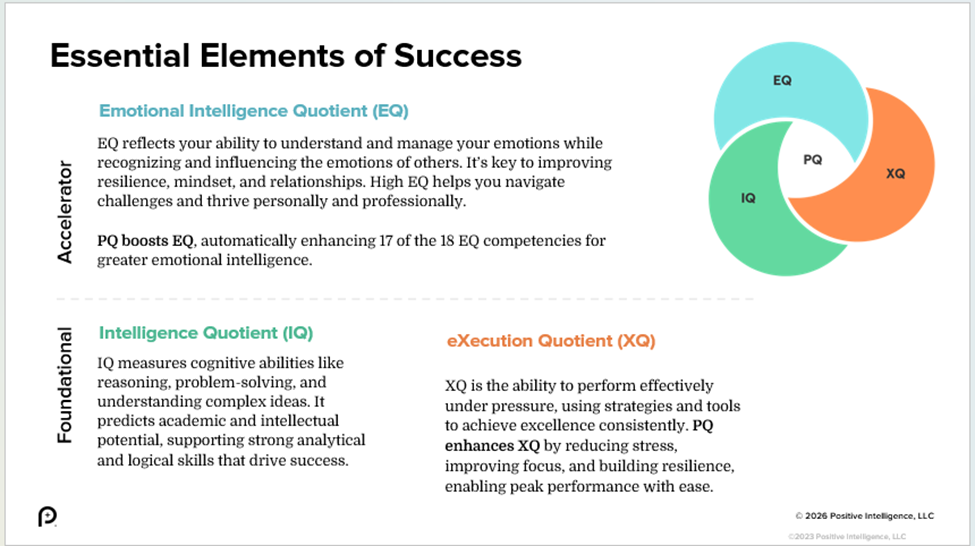
1. Intelligence Quotient (IQ): Necessary, but No Longer Sufficient
For decades, IQ has been treated as the primary predictor of success. Our education systems reward it. Organizations hire for it. Leaders often rely on it as their core differentiator.
But the current landscape has made one thing clear: IQ alone cannot carry us through complexity. It is foundational, but it does not help us navigate ambiguity, inspire people, or build resilient cultures.
2. eXecution Quotient (XQ): Turning Insight Into Action
XQ was a new term for me, but it names something we’ve long valued: the ability to deliver results. Intelligence matters, but execution is what moves organizations forward.
Yet an overemphasis on execution can create blind spots. When results become the only metric, culture erodes, burnout accelerates, and leaders lose sight of the human system that makes execution possible.
AI adds another layer of complexity. Increasingly, tasks that rely on IQ and XQ can be automated. This raises the question: What remains uniquely human in leadership?
3. Emotional Intelligence Quotient (EQ): The Human Differentiator
EQ has gained prominence for good reason. No leader succeeds alone. We need teams that are engaged, collaborative, and capable of navigating conflict and change.
EQ is the catalyst for this. It enables leaders to:
- Build trust
- Foster psychological safety
- Navigate tension with clarity
- Inspire people toward a shared vision
AI can model aspects of EQ, but it cannot embody it. The relational work of leadership—empathy, presence, attunement—remains distinctly human.
4. Positive Intelligence (PQ): The Operating System for Modern Leadership
PQ is the mental fitness that allows leaders to integrate IQ, XQ, and EQ. It is the capacity to:
- Stay self-aware
- Regulate the nervous system
- Remain grounded in difficult conversations
- Discern between reactive patterns and wise action
PQ strengthens the neural pathways that support resilience, clarity, and intentional leadership. In a time of rapid change, PQ is not optional—it is the operating system that enables all other skills to function.
Why This Moment Is a Gift
The challenges of our time are stretching us, but they are also calling us into a higher level of leadership. They are pushing individuals, teams, and organizations to evolve—to lead with more humanity, more awareness, and more intentionality. This is the work of modern leadership.
I am working with a leader who was recently given a high-level project to lead cross-sectional teams in navigating the use of AI in their work. He was chosen for this leadership position not because of his IQ or XQ. The upper leadership knew this had to be a given. He was chosen for his personal development work in his EQ and PQ to lead multiple teams and people in collaborating on the integration and application of AI.
Reflection Questions for Leaders
- Where are your strengths—and your growth edges—across IQ, XQ, EQ, and PQ?
- Which quotient represents your biggest gap right now?
- What is one action you can take this week to strengthen that area?
Book Recommendation
If you want to deepen your mental fitness, I recommend Beyond Belief, a science-backed guide to unlocking the mindset and neural pathways that support sustainable leadership.